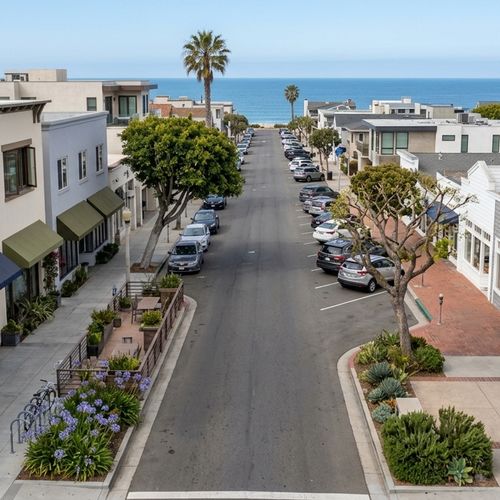


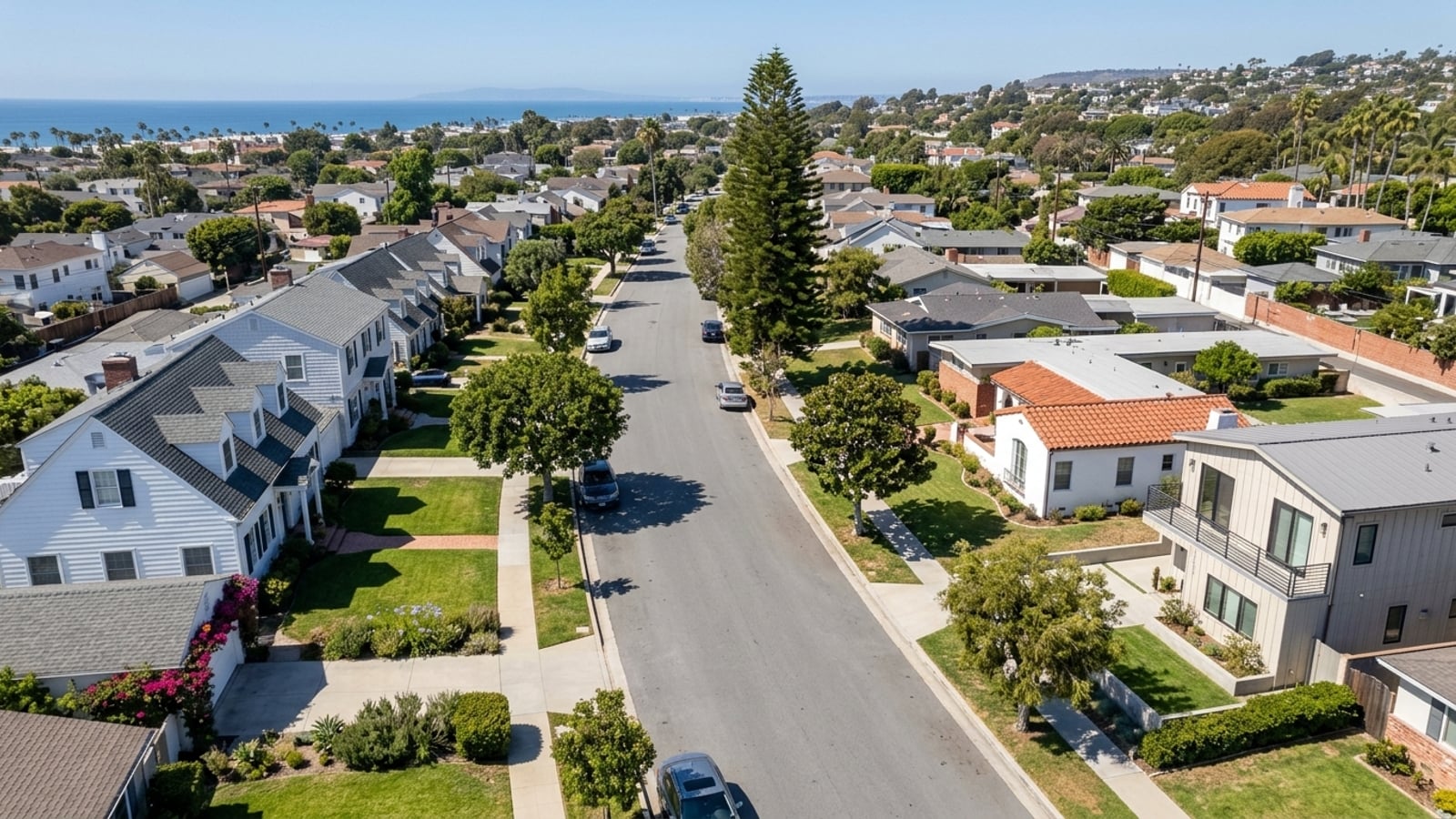
In Manhattan Beach, CA, how you get around is decided by which section you buy in, not by public transit routes. The Sand Section supports a daily walk-and-bike routine. The Hill and Tree sections generally require climbing steep grades or driving.
The compact, lower-upkeep format is where buyers have negotiating room right now. Townhouse prices fell 17.3% year over year and took a median 76 days to sell in the 90 days ending September 30, 2026, based on a small sample of 16 sales. Single-family homes, meanwhile, sold in 33 days at 100.1% of list price.
Key takeaway
If you want to handle most days on foot or by bike, start your search in the Sand Section, where downtown, the pier, and the Strand sit close together. The Hill and Tree sections trade that flat walk for a car- or bike-based routine. If you want negotiating room, look at townhouses, which closed at 98.9% of list in the latest 90 days based on 16 sales, but check each listing's walk to downtown yourself.
Who this guide is for
You're considering a move to Manhattan Beach and want to know how much of daily life you can manage without a car before you decide which section and what kind of home to search for.
How getting around Manhattan Beach works
Townhouses took a median 76 days to sell in the 90 days ending September 30, 2026. Single-family homes closed in just 33 days. That gap matters because it gives townhouse buyers room to negotiate on a compact property. Inventory is thin, only 4 units listed recently, so there's not much to choose from, but what's there tends to sit.
Public transit plays a minor role in daily life here. The real transportation variable is how far a home sits from the beach strip and downtown. A hill between your front door and the sand determines whether a quick trip requires a car. Buyers looking for a detached house should know their preferred commute before they start touring.
Townhouse savings mostly come from buying less space. The per-foot price gap between attached and detached homes is small. You can review Housing market trends and prices to see how these property types compare over time.
Getting around each section of the city
The city divides into distinct areas with different topographies, and the boundaries dictate your daily route. How you travel depends on whether you buy in the west, center, or east.
Sand Section
Some Sand Section streets are walk streets, pedestrian-only paths to the sand where cars can't drive. Homes on these streets are reached from an alley behind the property, so you walk to your front door and drive in through the back. This is the only section where a car can realistically sit parked for days, since the pier, downtown dining, and the Strand are a short, flat walk away.
The tradeoff is that parking is the tightest in town. Lots are narrow, garages are often small and alley-accessed, and visitor parking fills fast on summer weekends. Ask the seller for garage interior dimensions and confirm the address's residential permit zone before you assume there's room for a second car.
Hill Section
The beach and downtown are close as the crow flies, but walking or biking means a descent going out and a steep climb coming home. Many residents mix walking, traditional bikes, e-bikes, and short drives to handle the grade.
Walk or bike the route from a listing to downtown and back, including the uphill return, at the time of day you'd make that trip, before assuming you'll go car-free.
Tree Section
The Tree Section takes its name from its streets, many of which are named after trees. It sits farther east, closer to the arterials that lead toward El Segundo, LAX, and the 405. Driving trips start more easily here than from the beach strip, and the street grid avoids the immediate downtown traffic.
The catch is that the beach and downtown are a longer walk, often with an incline and a busy-road crossing on the way. Expect more trips by car or bike than in the Sand Section, and check how close the listing sits to Sepulveda Blvd traffic.
You can read more in our Neighborhood comparison or look at the direct differences in our Sand Section vs Tree Section and Hill Section vs Sand Section breakdowns.
How to narrow your search
Buyers looking for detached houses face a median 33-day market, so you should know your preferred commute before you start touring. If you want to walk to the beach, the pier, and downtown restaurants on most days without moving a car, start with the Sand Section.
If you'll drive to work most days toward El Segundo, LAX, or the 405, the Tree Section offers an easier daily drive that skips downtown beach traffic. Buyers who struggle with steep streets should test the Hill Section's grade in person before writing an offer.
If your budget points to a townhouse rather than a detached house, you have room to negotiate on price. Attached listings exist across the city, so apply these same geographic rules to the complex's location.
Walking and biking in Manhattan Beach
Under a 2023 City of Manhattan Beach ordinance, the Marvin Braude Bike Trail enforces a 15 mph speed limit for bicycles, e-bikes, and motorized bicycles. This path runs parallel to the pedestrian Strand on the sand. The city also maintains a "Walk Only Zone" on both sides of the pier where riders must dismount.
E-bike violations carry escalating maximum fines: up to $500 for a first offense and up to $1,000 for multiple violations within a year, charged as misdemeanors. East of the beach strip, the city's hills dictate how practical walking is, which is why e-bikes are a common choice for the incline.
If biking is your primary commute, test the grade from the listing to your daily stops. You can explore Things to do and destinations to map out your likely routes. For a townhouse, ask the HOA for its rules on bike and e-bike storage before you assume there's a place to put one.
Driving, parking and commuting
Sepulveda Blvd, Manhattan Beach Blvd, and Rosecrans Ave are the main arterials moving traffic out of the city toward the 405 and LAX. The city is compact, so reaching these roads takes only a few minutes from the eastern sections. Starting from the sand adds time on tighter streets.
The City of Manhattan Beach administers several residential parking permit programs to manage street spaces, including a Downtown Residential Override permit, a Mira Costa Residential Override permit to manage student parking, and a petition-based Tree Section program. Confirm with the city whether an address sits in a permit zone and how many permits it qualifies for.
Garage size and alley access matter when you buy, especially near the water where lots are narrow. Ask the seller for garage interior dimensions and whether alley access fits your vehicles, and visit on a summer weekend to see what street parking near the listing looks like.
Public transportation in Manhattan Beach
Manhattan Beach is served primarily by Beach Cities Transit Lines 102 and 109, along with LA Metro Local Line 232. Line 232 runs along Sepulveda Blvd through the city, connecting the LAX transit center to Downtown Long Beach.
The nearest Metro Rail station is the Redondo Beach station on Marine Avenue, which serves as the southern terminus of the K Line. Residents can reach that rail station using Beach Cities Transit Line 109. Always check current Beach Cities Transit and Metro schedules before relying on a route for a commute.
Manhattan Beach Dial-A-Ride offers shared-ride, curb-to-curb bus service for residents who are 55 or older, or disabled. Fares are $0.25 each way within the city and $0.50 for designated medical sites in Hermosa Beach, Redondo Beach, and Torrance. Ask the city whether a household member qualifies, or whether LA Metro and Access paratransit fit your needs better. If you need help matching Buying a home and current prices to a specific commute, we can help you map the routes.
Manhattan Beach housing market at a glance
- All homes, median sale price: $3,285,935, down 3.8% year over year (110 sales, 90 days ending Sept 30, 2026)
- All homes, median days on market: 40; median sale-to-list: 99.8%; sold above list: 30.6% (90 days ending Sept 30, 2026)
- All homes, months of supply: 2.2; inventory: 78; median price per sq ft: $1,560 (90 days ending Sept 30, 2026)
- Single family, median sale price: $3,908,442, up 11.7% year over year (84 sales, 90 days ending Sept 30, 2026)
- Single family, median days on market: 33; median sale-to-list: 100.1%; sold above list: 33.7% (90 days ending Sept 30, 2026)
- Single family, months of supply: 2; inventory: 56; median price per sq ft: $1,588 (90 days ending Sept 30, 2026)
- Townhouse, median sale price: $2,881,284, down 17.3% year over year (based on only 16 sales, so treat with caution; 90 days ending Sept 30, 2026)
- Townhouse, median days on market: 76; median sale-to-list: 98.9%; sold above list: 18.7% (based on 16 sales; 90 days ending Sept 30, 2026)
- Townhouse, months of supply: 0.8; inventory: 4; median price per sq ft: $1,505 (based on 16 sales; 90 days ending Sept 30, 2026)
Review our Pros and cons of living here for a deeper look at the area. If you want to see how these prices translate to specific streets, we can guide your search.
Getting around Manhattan Beach FAQs
How walkable is Manhattan Beach?
It's very walkable in the western sections. Manhattan Beach has a citywide Walk Score of 73 and a Bike Score of 52. Walkability is highest near downtown and the beach, dropping as you move east into the hills.
Where can you park in Manhattan Beach, and how much does it cost?
You can park in downtown and pier lots, structures, and at street meters. Under rates effective August 1, 2026, summer meter rates run $3.50 per hour for downtown street parking, $4 per hour for beach lots, and $3 per hour for downtown lots and garages. Check posted signs to confirm current rates, as off-season pricing drops slightly.
Is the beach in Manhattan Beach free and open to the public?
Yes, the beach is free and open to the public. While accessing the sand costs nothing, parking in the lots near the beach requires payment at the meters.
How far is Manhattan Beach from LAX?
It's approximately 5 to 6 miles from central Manhattan Beach to LAX. The drive takes about 11 to 12 minutes in non-rush-hour conditions. Check your route during peak hours, as times vary with traffic.
How far is Manhattan Beach from downtown Los Angeles?
Manhattan Beach is 19 miles southwest of downtown Los Angeles. Driving time is typically 25 to 35 minutes depending on traffic. You can also use the Redondo Beach Metro station for a transit alternative.
How much does the bus cost in Manhattan Beach?
For full-fare LA Metro riders using a TAP card, the 1-day fare cap is $5.00 and the 7-day fare cap is $18.00. Reduced fare caps for seniors and disabled riders are $2.50 for one day and $5.00 for seven days. Confirm current Beach Cities Transit and Metro fares with the agencies before riding.
What county and ZIP code is Manhattan Beach, CA in?
Manhattan Beach is located in Los Angeles County. The city is served by ZIP code 90266, with 90267 used for PO boxes. Because it sits in LA County, LA Metro and Access paratransit serve the city.
How big is Manhattan Beach?
According to the U.S. Census Bureau, Manhattan Beach has a land area of 3.9 square miles. That small footprint means drives across town are short, but the hills determine whether walking works for your daily routine.
Sources
- Redfin: Data Center
- City of Manhattan Beach: E-bike Ordinance
- City of Manhattan Beach: Parking Permits
- City of Manhattan Beach: Maps and Directions
- Wikipedia: Redondo Beach station
- City of Manhattan Beach: Dial-A-Ride
- Walk Score: Manhattan Beach, CA
- South Bay Tide: Parking Meters
- City of Manhattan Beach: Facts
- TAP: Fare Capping
- Zip-Codes.com: Manhattan Beach
Check out this article next