

The median home price in Manhattan Beach, CA sits around $3.28 million, making it one of the most expensive housing markets in Los Angeles County. Buyers targeting this coastal city face high entry costs, competitive bidding on detached houses, and steep monthly carrying costs driven by jumbo mortgage rates.
The true cost of living here requires looking past the headline medians to see how different property types dictate your budget. The financial reality of buying a house a few blocks from the pier is entirely different from purchasing a townhouse further inland, and knowing those differences is how you build a realistic housing budget.
Key takeaway
Housing drives the cost of living in Manhattan Beach, and the cheapest way in right now is a townhouse rather than a house. Townhouse prices fell, based on 16 sales, and they sit on the market longer, which gives you room to negotiate. If you need a yard and more space, plan on single-family homes, where prices are rising and about a third sold above list price.
Who this guide is for
You're weighing a move to Manhattan Beach and need to work out what it would cost each month to own or rent there, and which type of home keeps that number manageable.
Manhattan Beach cost of living in 2026
The citywide 3.8% price drop is accurate and also misleading. It's the average of two markets moving in opposite directions: single-family homes rose strongly and a third sold over asking, while townhouses fell (based on 16 sales) and took a median 76 days to sell. So when you hear prices are falling, that's true for one type of home only.
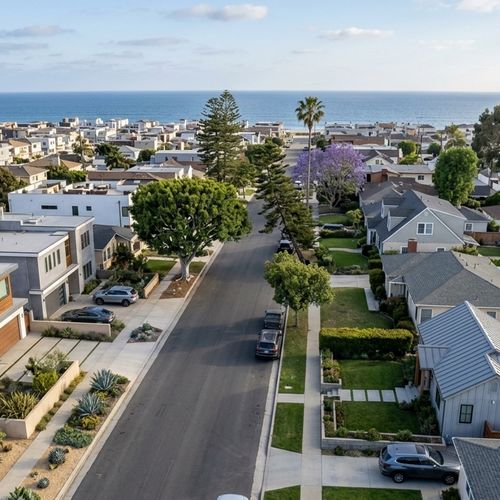
Housing dominates the local cost of living because supply is fixed in a small, built-out beach city. Buyers also pay a premium for beach access and the Manhattan Beach Unified School District. Check school assignment for a specific address directly with the Manhattan Beach Unified School District locator (the district office is at 325 South Peck Ave.) and don't rely on a listing description. Your exact location within the city changes your daily logistics and your purchase price.
You can find the exact market figures in the at-a-glance list below. For a broader view, review local housing market trends and outlook, or weigh the pros and cons of living in Manhattan Beach if you're still comparing cities.
Single-family home or townhouse: the biggest cost decision
This is the most consequential choice you'll make before you ever make an offer. The realistic way to lower your cost of living here is a townhouse bought with negotiating room, accepting less space rather than a cheaper rate per square foot. Single-family homes require a completely different financial commitment, and buyers in that segment face a market where hesitation costs you the house.
Townhouse buyers trade a private yard for more room to negotiate at the table. Whether that trade works for you is worth settling before you start touring.
Single-family homes
The median sale price for a single-family home reached $3,908,442 over the 90 days ending September 30, 2026. Demand remains strong in this segment, with 33.7% of houses selling above list price and the typical home going under contract in a median 33 days. Plan to offer at or above list and to move quickly after touring.
That price increase came from 84 sales, which is a solid sample of market direction. With only about two months of supply, there's little room to negotiate. Price your inspections and contingencies carefully, because waiving them to compete is how buyers here overpay.
Townhouses
The typical townhouse took more than twice as long to sell as a house and closed at 98.9% of the list price. Sellers in this segment are more open to price cuts, credits, or repairs. The typical townhouse sold for $2,881,284, about $1 million less than the typical single-family home.
Some Manhattan Beach townhouses are condo-mapped, meaning shared ownership of land and common areas with a homeowners association, while others are fee simple. Ask whether a townhouse is condo-mapped or fee simple, and confirm with your lender how that affects financing. Only four townhouses were for sale at the end of the window, so you may have room to negotiate on price but very little choice. Expect to wait for the right unit, and remember that a 16-sale median can swing sharply from one quarter to the next.
What price per square foot tells you
Townhouses cost a median $1,505 per square foot, while single-family homes run $1,588. That's about a 5% difference per square foot, but about 26% less overall, which tells you where the savings come from: you're buying fewer square feet, not a materially cheaper rate.
Compare listings on price per square foot and layout, not just the headline price. Medians mix very different homes, from small older units to new builds. A townhouse priced well below the median per square foot may need work, so pull comparable sales for the specific building or block before you treat it as a deal.
What it costs to own a home in Manhattan Beach
Purchase price is the starting point. What you'll write a check for each month is a different number, and it's the one that determines whether you can sustain the decision. A worked example using the recent median prices for both property types is the clearest way to see what you're taking on.
Down payment and loan size
At the townhouse median, a 20% down payment is $576,257, leaving a $2,305,027 loan. At the single-family median, 20% down is $781,688, leaving a $3,126,754 loan. Both loans sit far above the 2026 Federal Housing Finance Agency conforming loan limit of $1,249,125 for Los Angeles County, so you'll need a jumbo loan, which recently carried an average rate of 7.28% for a 30-year fixed mortgage.
At that rate, principal and interest on the townhouse loan runs about $15,750 a month, while the single-family loan requires around $21,366 a month. Jumbo lenders often ask for larger down payments and months of payments held in reserve after closing, so the cash you need can run well past the down payment. Ask your jumbo lender for its reserve requirement in writing.
Property taxes under Proposition 13
Under California's Proposition 13, the base property tax rate is 1% of the purchase price. At the townhouse median that works out to about $28,813 a year; at the single-family median, about $39,084. Voter-approved debt and special assessments push the all-in property tax rate for Manhattan Beach to roughly 1.108359% of assessed value for the 2025-26 fiscal year.
A new owner's property tax is based on their purchase price, so the seller's current tax bill tells you almost nothing about yours. Look up the property's current tax bill and special assessments with the Los Angeles County Treasurer and Tax Collector. A supplemental tax bill usually arrives after closing to catch up the reassessment, so set that money aside rather than counting on your lender's escrow account to cover it.
HOA dues and insurance
Townhouse buyers should ask the HOA for current dues, the latest reserve study, and any planned special assessments. A low HOA fee with thin reserves can turn into a large special assessment later, and that's not a risk you want to discover after you've closed.
All buyers need to secure homeowners insurance early. The California Department of Insurance recently approved a 29.1% average rate increase on the FAIR Plan's dwelling line, effective October 2026. The FAIR Plan raised its residential dwelling coverage cap to $3 million, and earthquake coverage requires a completely separate policy. Get homeowners and earthquake insurance quotes before removing contingencies, since quotes can change between offer and closing.
Putting the monthly number together
The townhouse scenario requires about $15,750 for principal and interest, plus roughly $2,661 a month in property taxes, before adding HOA dues and insurance. The single-family home demands around $21,366 for the mortgage and $3,610 for taxes, plus insurance. Choosing a detached house over a townhouse adds several thousand dollars to your monthly carrying costs.
This is a median-price illustration, not a quote. Rates, your down payment, and the specific home's tax add-ons can move the total by thousands a month, so rerun it with a lender's numbers. Review the buying process and closing costs for the full transaction picture.
Renting and everyday costs in Manhattan Beach
Renting first is a practical way to test the city before committing to the purchase costs outlined above. It also buys you time to understand which neighborhoods fit how you live.
Renting in Manhattan Beach
The Department of Housing and Urban Development set FY2026 Fair Market Rents for Los Angeles County at $2,079 for a studio, $2,328 for a one-bedroom, and up to $4,098 for a four-bedroom. Renting allows newcomers to experience different neighborhoods before taking on a jumbo mortgage and property taxes.
County-level fair market rents understate beach-city rents, and Census figures lag today's asking rents. Treat both as a floor and check current listings for the specific street.
Utilities: electricity, gas and water
Southern California Edison provides electricity, while SoCalGas supplies natural gas. The City of Manhattan Beach handles water and sewer service billing directly. Bills depend on the home's age, size, insulation, and whether it has a pool or heavy yard watering requirements. Ask the seller or landlord for 12 months of actual utility bills.
Groceries, gas and getting around
Non-housing costs run at metro-area levels, with the Consumer Price Index for the Los Angeles area rising 0.5% in September 2026. Local gas prices in the Los Angeles-Long Beach metro area recently averaged $6.01 per gallon.
Metro averages hide how much you'll drive. A long freeway commute can add more to your monthly costs than groceries, so drive your commute route at rush hour before choosing between neighborhoods. You can explore things to do in Manhattan Beach to map out your lifestyle and entertainment spending.
How costs differ by neighborhood
The housing market data doesn't break out prices by section, so these profiles describe how cost pressures differ across the city rather than quoting section medians. Proximity to the water drives property values, creating clear trade-offs between lot size, privacy, and beach access. Where you land within the city shapes both your purchase price and how you manage daily logistics.
Sand Section
Proximity to the sand and pier is what you're paying for, and it changes daily costs as well as price through tight lots, visitor traffic, and parking pressure. Some Sand Section homes front walk streets, which are pedestrian-only streets with no car access at the front door. The city regulates private use of the public right-of-way on these streets through its Encroachment Standards.
Parking and garage space can be scarce. Confirm off-street parking spaces on the listing and whether the street requires a residential parking permit.
Tree Section
Buyers here trade a short walk to the beach for more room and quieter streets. Older homes on desirable lots are often bought to remodel or rebuild, so the purchase price can be only part of the cost. Get a contractor estimate and check city permit requirements before you offer. Review the Sand Section vs Tree Section comparison to see how the two areas stack up.
Hill Section
Elevation and the possibility of ocean views sit between the Sand and Tree Sections. Views vary lot by lot, so confirm sightlines from the property yourself. You pay for a view that a neighbor's remodel could change, so ask whether any view protection applies to the specific lot rather than assuming it does. You can compare the Hill Section vs Sand Section to evaluate the premium for elevation.
East Manhattan Beach
This is the area east of Sepulveda Boulevard, where buyers look when space per dollar matters more than beach access. The beach becomes a drive rather than a walk, and Sepulveda traffic is part of daily life. Compare recent sales east and west of Sepulveda for the same home size to see the difference, and visit at rush hour before deciding. You can read the best neighborhoods in Manhattan Beach guide for more details.
Questions to narrow your budget
- Do you need a detached house with its own yard, or would shared walls work? If shared walls work, read the townhouse section first; if not, go to the single-family section and budget to pay list price.
- Can you qualify for a jumbo loan and the cash reserves lenders ask for, or would renting first make more sense? The worked example in 'What it costs to own a home in Manhattan Beach' answers the first; 'Renting in Manhattan Beach' answers the second.
- Is walking to the sand worth a higher price and tighter parking? If yes, start with the Sand Section profile; if space matters more, compare the Tree Section, Hill Section and East Manhattan Beach profiles.
- How much time can you give a negotiation? If you can wait out a listing, the townhouse market rewards patience; if you need to win a specific house fast, the single-family section explains why that costs more.
Charles Fisher at Estate Properties can pull comparable sales for a specific townhouse or block to help you weigh these options. This is general information, not financial or tax advice.
At a glance
- All homes (90 days ending 2026-09-30, 110 sales): median sale price $3,285,935, down 3.8% year over year; median $1,560 per square foot.
- All homes (90 days ending 2026-09-30): median 40 days on market; sold at 99.8% of list price; 30.6% sold above list; 2.2 months of supply; 78 homes for sale.
- Single-family homes (90 days ending 2026-09-30, 84 sales): median sale price $3,908,442, up 11.7% year over year; median $1,588 per square foot.
- Single-family homes (90 days ending 2026-09-30): median 33 days on market; sold at 100.1% of list price; 33.7% sold above list; 2.0 months of supply; 56 homes for sale.
- Townhouses (90 days ending 2026-09-30, based on only 16 sales, so treat with caution): median sale price $2,881,284, down 17.3% year over year; median $1,505 per square foot.
- Townhouses (90 days ending 2026-09-30, based on 16 sales): median 76 days on market; sold at 98.9% of list price; 18.7% sold above list; 0.8 months of supply; 4 homes for sale.
Manhattan Beach cost of living FAQs
How expensive is Manhattan Beach, California?
The all-homes median sale price in Manhattan Beach sits at $3,285,935 based on 110 sales over the 90 days ending September 30, 2026. This ranks it among California's most expensive cities and places it well above the overall Los Angeles County median. Because the single-family and townhouse markets behave very differently, check the property-type breakdown above for specific costs.
Is Manhattan Beach more expensive than Hermosa Beach or Redondo Beach?
Yes, Manhattan Beach consistently records a higher median sale price than neighboring Hermosa Beach and Redondo Beach. Buyers should check the latest Redfin median sale prices for Hermosa Beach and Redondo Beach to compare the exact premium for a given quarter.
What salary do you need to live in Manhattan Beach?
A townhouse carrying about $18,400 a month in principal, interest, and property taxes would require an annual gross household income of roughly $790,000 to keep housing at 28% of gross income. Single-family homes require substantially more to maintain that same ratio. Lenders set their own debt-to-income limits, so get a pre-approval for the real figure.
What is the sales tax rate in Manhattan Beach?
As of October 1, 2026, the total sales and use tax rate within the City of Manhattan Beach is 10.75%. This consists of 6.5% for the State, 1.0% for the City, and 3.25% for Los Angeles County. This rate applies to retail purchases like furniture and cars after a move.
How much does parking cost in Manhattan Beach?
On-street peak-season meter rates run $3.50 an hour citywide and $4.00 an hour at beach and pier lots, dropping slightly off-peak. Overnight residential beach-lot parking permits cost $30 for three months, while preferential-parking override hangtags are $15 for the first tag. Confirm whether a specific street is in a permit zone before you rent or buy.
Is Manhattan Beach part of Los Angeles?
No, Manhattan Beach is its own incorporated General Law city in Los Angeles County, established on December 2, 1912. It operates its own city services, including a police department and water billing. This separates your local utility and municipal fees from the City of Los Angeles.
How far is Manhattan Beach from LAX?
Los Angeles International Airport is located about three miles south of the city. Drive times vary widely by hour and traffic conditions. Test the route at your actual travel time to gauge the commute.
Is Manhattan Beach safe?
The Manhattan Beach Police Department publishes 2025 NIBRS-based crime statistics, noting that over 90% of vehicle thefts involve valuables left in plain view and nearly 65% of those vehicles were left unsecured. When reviewing rates per 1,000 residents, remember that visitor populations in a beach city can inflate per-capita counts. Check the department's official crime statistics page for specific areas.
Sources
- Redfin: Data Center
- FHFA announces baseline conforming limits
- MBA Weekly Mortgage Applications Survey
- Manhattan Beach Property Taxes
- California FAIR Plan Updates
- HUD Fair Market Rents for the Housing Choice Voucher Program
- BLS Consumer Price Index Los Angeles Area
- AAA Auto Club State Average Gas Prices
- City of Manhattan Beach Zoning & Development Regulations
- California Department of Education School Directory
- City of Manhattan Beach Quarterly Sales Tax Updates
- City of Manhattan Beach Parking Permits
- City of Manhattan Beach Facts
- Manhattan Beach Police Department Crime Statistics
Check out this article next