

Manhattan Beach covers four square miles along Santa Monica Bay, but its specific lot lines were drawn more than a century ago. The way developers carved up the sand in the early 1900s still dictates where you can park, how big your yard is, and what you pay for a house today.
Key takeaway
Manhattan Beach was named in 1902 by founder Stewart Merrill after Manhattan Island in New York, and it became a city in 1912. The narrow beach lots and walk streets platted then still define the Sand Section today. That fixed supply of detached land helps explain why single-family homes are the city's most expensive and most competitive homes. If you'd rather see the history than read it, start at the pier, and visit the historical society's museum once it reopens.
Who this guide is for
You're curious how Manhattan Beach came to be, or you're weighing a home here and want to understand why the Sand, Hill and Tree sections look and price so differently.
How to use this guide
For the name and founding story, start at the 1902 naming entry in the timeline and read forward. If you're trying to work out why one part of town has tiny lots and walk streets while another has yards, go to how history shaped the neighborhoods. To plan a visit around the history, read what the city is known for, then where to see its history in person. If you're weighing a purchase, skip to what the history means for buyers today and the at-a-glance market numbers.
What is the history of Manhattan Beach, CA?
Manhattan Beach's housing map is a record of its history. The narrow beach lots and walk streets laid out in the early 1900s became today's Sand Section. Postwar growth filled the inland sections with bigger lots. Because that pattern has barely changed, detached land is the scarcest thing the city has to sell.
The land passed from its first Tongva inhabitants to a Spanish and then Mexican rancho. It was then subdivided into a beach tract of small cottages and incorporated as a town. After World War II it grew into a suburb. Over the last half-century it became a high-value city as those cottages gave way to much larger homes on the same lots. Each step happened inside the original lot lines rather than redrawing them.
Manhattan Beach history timeline
Before 1900: Tongva land and Rancho Sausal Redondo
The first known inhabitants of the area were the Engnovangas (Tongva) Rancheria Native Americans. In 1784, the Spanish government established ranchos along the South Bay. What is now Manhattan Beach was part of the original Spanish land grant for Rancho Sausal Redondo, which covered nearly 25,000 acres from Playa del Rey to Hermosa Beach. Antonio Ygnacio Ávila received the formal land grant from Mexican Governor Juan Alvarado on May 20, 1837.
Little physical trace survives from this period. Most of what's known comes from land records rather than visible sites.
1902: How Manhattan Beach got its name
The area was first called Shore Acres. In 1902, founder Stewart Merrill named the town after Manhattan Island in New York.
The name causes endless mix-ups with Manhattan Beach in Brooklyn. When you're researching old records, confirm which one a source means.
1912 to 1920s: Incorporation and the pier
The official date of incorporation was December 7, 1912, as filed with the Secretary of State. During these early years, developers platted the original narrow lots and built small beach cottages close to the sand.
The current concrete pier was completed and dedicated on July 5, 1920. It replaced earlier iron piers dating to 1897 that storms destroyed, the last in 1913. The Roundhouse at the end of the pier, completed in 1922, is the city's signature landmark.
Few early cottages survive. If a home's age matters to you, check its permit history with the City of Manhattan Beach rather than taking a listing's "original" label at face value.
1924: Bruce's Beach
In 1924, prompted by a petition from local white real estate agents and other citizens, the Manhattan Beach City Council voted to condemn a successful Black-owned resort site and surrounding land through eminent domain to build a park. Los Angeles County records state this process was racially motivated to end the business operated by Charles and Willa Bruce.
On June 28, 2022, the Los Angeles County Board of Supervisors approved the transfer of ownership back to the Bruce family. A month later, the board officially returned the land to the legal heirs of Charles and Willa Bruce. In January 2023, the family announced their decision to sell the beach back to the county for $20 million.
Secondhand accounts often get dates and sale terms wrong. Rely on the county's published documents and state bill text for exact figures.
1940s to 1960s: Postwar growth
Aerospace and defense employers in the South Bay drove a housing boom in the decades after World War II. That growth turned a small beach town into a full suburb, filling the inland part of the city with larger lots and single-story homes.
Many of those postwar homes have since been remodeled or rebuilt to the lot line. The modest houses of that era are now a shrinking share of what sells.
1970s to today: From beach town to high-value market
Rising land values over the last fifty years led to widespread teardowns, with small cottages replaced by much larger homes on the same narrow lots. The city's profile grew alongside its prices, aided by the popularity of local volleyball tournaments and the arrival of television and film studios.
The city has a Historic Preservation program. The City Council has also adopted a Mills Act program, which gives property tax reductions to owners of designated landmarks who agree to preserve them through a preservation agreement. If preservation matters to you, ask the city whether a property is a designated historic landmark or eligible for preservation incentives before planning any changes.
How history shaped Manhattan Beach neighborhoods
Sand Section
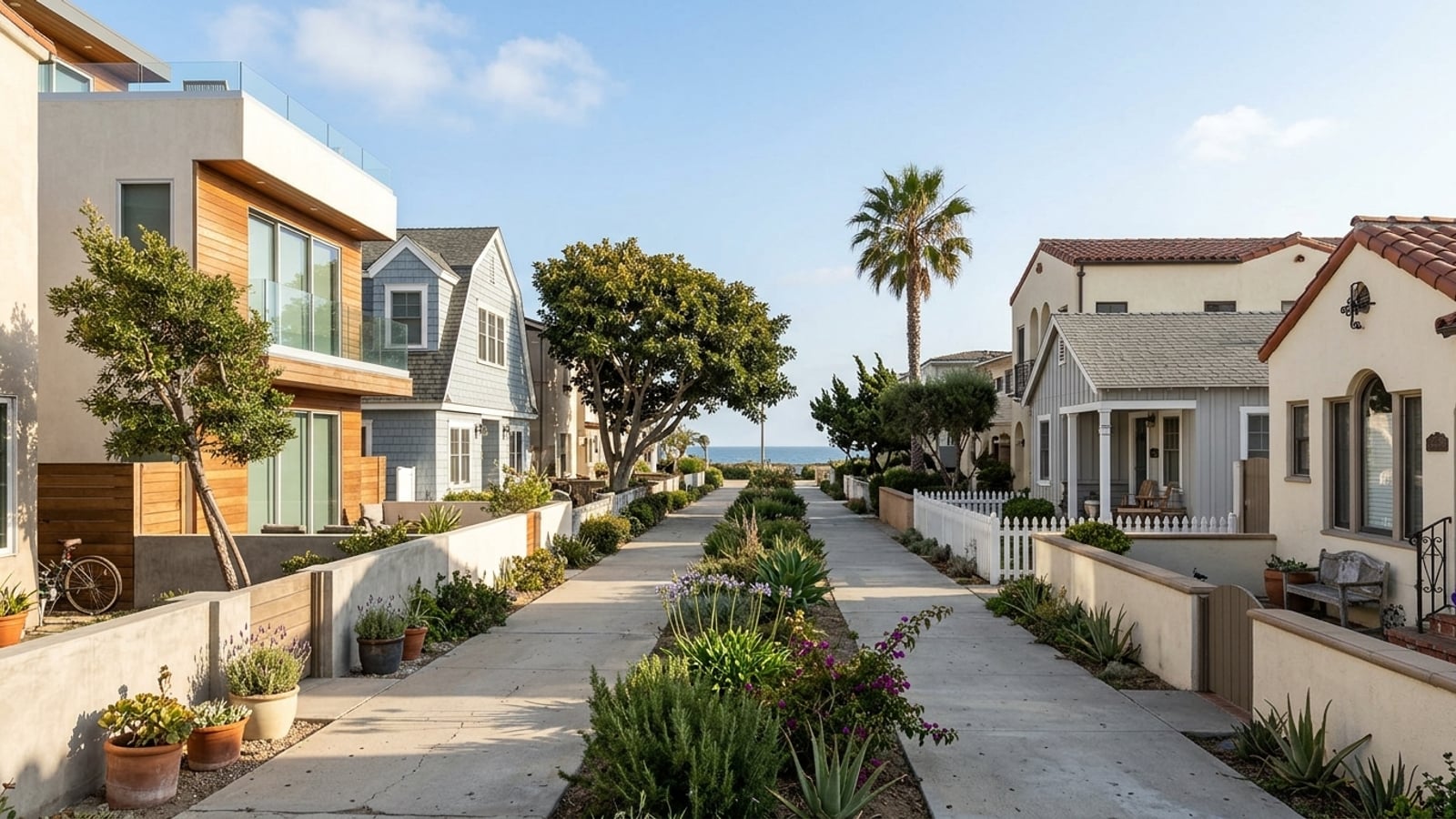
The Sand Section is where you can walk the original early-1900s beach-town layout. Its walk streets date back to the first subdivision. They are pedestrian-only paths lined with homes on narrow lots close to the sand, and some have no cars at all, only footpaths between front doors. Compared with the Tree Section, it trades yard space for steps to the beach.
Those narrow lots mean small yards and scarce parking. Garage access is often from an alley, so confirm parking, alley access and lot dimensions on any Sand Section listing.
Hill Section
Built on the high ground and former dune ridge east of the Sand Section, this is where the ocean views come from. The terrain slopes up from the older beach tracts into terraced lots that look out over the water. The choice between the Hill Section and the Sand Section comes down to elevation and views against immediate beach access.
What you give up is flat ground. Steep streets are part of the deal. A view you buy isn't automatically protected, so ask the city planning department what height and view rules apply to neighboring lots.
Tree Section
If you want a detached home with more yard than the original beach lots offer, the Tree Section is worth a close look. It was laid out on larger inland lots during the postwar build-out and takes its name from its tree-named streets.
The trade-off is beach proximity: the sand is a drive or a long walk away. Many original homes have been rebuilt, so the same permit check applies.
East Manhattan Beach
This is the most recently developed part of the city, sitting inland east of the major north-south corridor. The studios and the Manhattan Village shopping area are here, along with larger lots and easier access to the highway.
What you give up is ocean proximity. It sits farthest from the beach and closest to the busiest arterials, so drive the streets at rush hour before committing.
What Manhattan Beach is known for
Many of the things to do in Manhattan Beach grow out of these same historical landmarks.
Beach volleyball
The Manhattan Beach Open beach volleyball tournament has been held since 1960. It began as an amateur event before joining the professional tour and is often called the "grand daddy of beach volleyball tournaments."
Tournament weekends bring heavy crowds and tight parking near the pier. Check Manhattan Beach Open dates if you want to avoid or catch the crowds.
The sand dunes
The city originated on coastal dunes, much of which was leveled for building. Sand Dune Park preserves one of the remaining dunes, and local residents built the surrounding park on a converted dump site in 1964. Historical accounts note that one dune was reportedly spared from being shipped off to Hawaii's Waikiki Beach decades earlier. Santa Fe Railroad cars once hauled loads of local sand to San Pedro harbor for shipment.
Climbing the dune requires a reservation. Patrons 13 and older must book online and pay a fee, so check the city's current booking rules before you go.
Manhattan Beach Studios
The 22-acre studio campus was built in 1999 by Shamrock Holdings of California for the Roy E. Disney family. Its 15 sound stages, totaling 385,000 square feet, changed the commercial footprint of the east side. The property changed hands a few times before Hackman Capital Partners acquired it in 2019 for $650 million.
It's a working lot, not a tourist attraction. Don't plan a visit expecting public tours unless the studio announces them.
What Manhattan Beach's history means for buyers today
Because the early lot pattern fixed the supply of detached land, single-family homes draw the most competition, while townhouses offer room on price but few choices. Housing market prices and trends move quickly, so treat the figures here as a snapshot of the 90 days ending September 30, 2026. Buyers considering these options can read the pros and cons of living in Manhattan Beach.
Single-family homes
The single-family median sale price rose 11.7% year over year to $3,908,442, and 33.7% of single-family homes sold above list price. If you'd like help reading how a home's age and lot affect its value, Charles Fisher can walk you through comparable sales.
Bidding below list on a well-priced detached home rarely works here, so budget for list price or above.
Townhouses
If you want room to negotiate on price, townhouses are where it exists right now. The townhouse median sale price fell 17.3% year over year, and homes sat a median 76 days on the market, based on 16 sales.
The catch is inventory. Only 4 townhouses were listed, leaving just 0.8 months of supply. HOA dues add to the monthly cost, so ask the HOA for current dues and reserve studies before you're under contract.
Where to see Manhattan Beach history in person
Walk out on the pier to the Roundhouse for the 1920s waterfront. Then book a slot at Sand Dune Park to see the kind of dune the town was built on.
Manhattan Beach Historical Society museum
If you want the history in one stop, the Manhattan Beach Historical Society museum is it. It sits in Polliwog Park at 1601 Manhattan Beach Boulevard, in one of the town's early 1905 beach cottages, and holds photos and records of the original tract and the city's early development.
The museum is currently closed for cleaning, inventory and exhibit restoration. Check the society's website or social media for reopening news and hours before visiting.
At a glance
- All homes: median sale price $3,285,935, down 3.8% year over year, 110 homes sold (90 days ending 2026-09-30)
- All homes: median 40 days on market, 99.8% sale-to-list, 30.6% sold above list (90 days ending 2026-09-30)
- All homes: 78 listings, 2.2 months of supply, median $1,560 per sq ft (90 days ending 2026-09-30)
- Single family: median sale price $3,908,442, up 11.7% year over year, 84 homes sold (90 days ending 2026-09-30)
- Single family: median 33 days on market, 100.1% sale-to-list, 33.7% sold above list, median $1,588 per sq ft (90 days ending 2026-09-30)
- Single family: 56 listings, 2.0 months of supply (90 days ending 2026-09-30)
- Townhouse (based on 16 sales; read with caution): median sale price $2,881,284, down 17.3% year over year, median 76 days on market (90 days ending 2026-09-30)
- Townhouse (based on 16 sales; read with caution): 98.9% sale-to-list, 18.7% sold above list, 4 listings, 0.8 months of supply, median $1,505 per sq ft (90 days ending 2026-09-30)
Manhattan Beach history FAQs
Who owns Manhattan Beach Studios?
An affiliate of Hackman Capital Partners owns the MBS Media Campus, which it bought in 2019.
What has been filmed at Manhattan Beach Studios?
Productions include Lightstorm's Avatar sequels and Lucasfilm's The Mandalorian, Obi-Wan Kenobi and The Book of Boba Fett. Marvel's The Avengers, Captain America and Iron Man 2 were filmed there too, along with TV shows such as Jane the Virgin and Insecure.
What was Manhattan Beach originally called?
It was called Shore Acres before founder Stewart Merrill renamed it in 1902.
Is Manhattan Beach man-made?
The town sits on natural coastal dunes, but the wide beach was artificially widened. About 22.2 million cubic meters of fill added to the Santa Monica Bay shoreline over the past half-century created the stable beaches seen today.
When was the Manhattan Beach Pier built?
The current pier was dedicated on July 5, 1920, and the Roundhouse at its end followed in 1922.
What county is Manhattan Beach, CA in?
Manhattan Beach is in Los Angeles County, in the South Bay at the southern end of Santa Monica Bay. Its ZIP code is 90266.
Is Manhattan Beach, CA expensive?
Yes. In the 90 days ending September 30, 2026, the all-homes median sale price was $3,285,935, at a median $1,560 per square foot.
Sources
- Redfin: Data Center
- Los Angeles County Department of Beaches & Harbors: Manhattan Beach
- City of Manhattan Beach: History
- Los Angeles County Anti-Racism, Diversity, and Inclusion Initiative: Bruce's Beach
- City of Manhattan Beach: Historic Preservation
- City of Manhattan Beach: Calendar
- City of Manhattan Beach: Parks and Facilities
- MBS Media Campus: About
- ASCE Civil Engineering Database: Santa Monica Bay
- Manhattan Beach Historical Society
- City of Manhattan Beach: Facts
Check out this article next